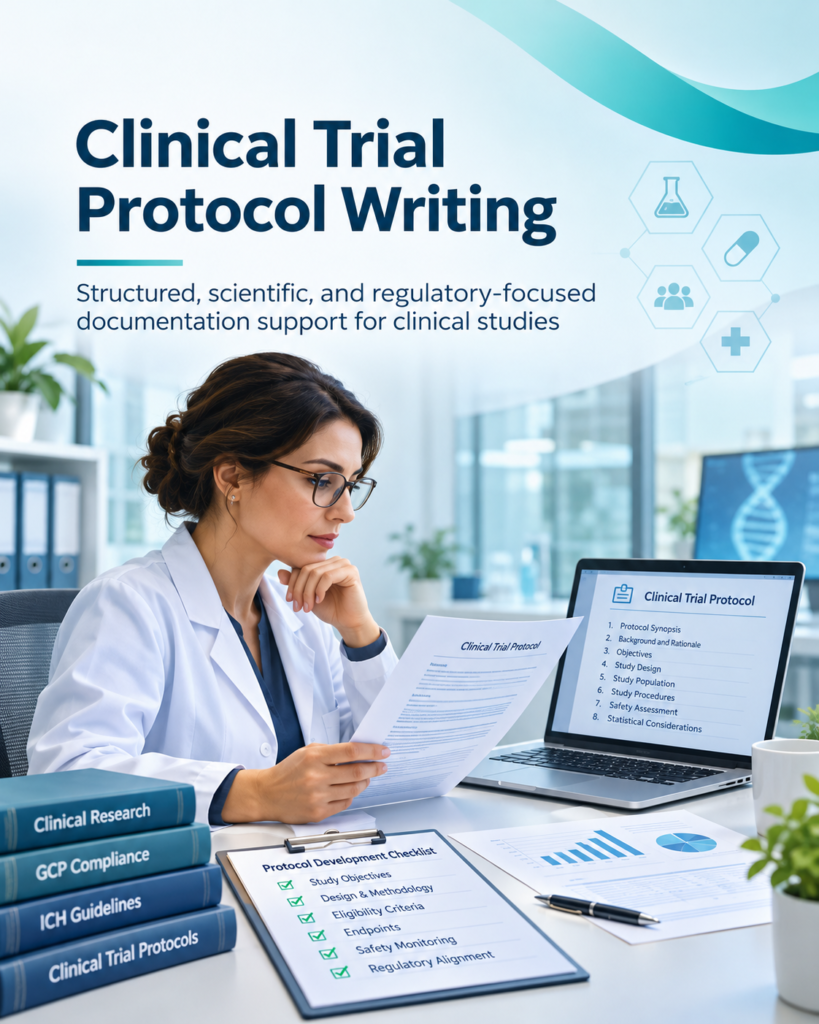
Scientific, structured, and regulatory-aware protocol documentation support for pharmaceutical companies, biotechnology organizations, and contract research organizations (CROs).
From initial protocol development to scientific review and protocol amendments, Hinfoma Global supports clinical research documentation needs.
Clinical trials play a vital role in the development of new pharmaceutical products, biological therapies, and medical treatments. Successful clinical research requires comprehensive planning, scientific accuracy, and appropriate regulatory documentation. Among the essential documents required for conducting a clinical study, the Clinical Trial Protocol serves as the foundation for study planning and execution.
A Clinical Trial Protocol describes the study objectives, design, methodology, participant eligibility criteria, treatment procedures, safety assessments, and statistical considerations. Preparing a high-quality protocol requires scientific knowledge, regulatory understanding, and specialized medical writing expertise.
However, developing and maintaining clinical trial protocols can be challenging for pharmaceutical companies, biotechnology organizations, and Contract Research Organizations (CROs), particularly when internal resources are limited.
Outsourcing clinical trial protocol writing services has therefore become an important option for organizations seeking specialized medical writing support, structured documentation processes, and efficient resource management.
Clinical Trial Protocol Writing is the process of preparing a structured scientific and regulatory document that describes how a clinical study will be conducted.
The protocol provides detailed instructions to investigators, sponsors, CROs, and other clinical research personnel regarding study conduct.
Outsourcing protocol writing allows pharmaceutical companies and CROs to access specialized medical writing expertise without relying exclusively on internal resources.
The following are some important reasons organizations consider outsourcing clinical protocol development.
Clinical trial protocol development requires an understanding of clinical research methodologies, therapeutic areas, scientific literature, and regulatory expectations.
Professional medical writers with clinical research experience can help transform scientific and clinical information into structured, clear, and consistent protocol documentation.
We can support the preparation of protocol sections, review scientific content, and coordinate document revisions based on sponsor and subject matter expert feedback.
Access to specialized writing expertise is particularly useful for organizations managing multiple clinical studies or working across different therapeutic areas.
A clinical trial protocol must present study information clearly and consistently.
Inconsistencies between study objectives, endpoints, eligibility criteria, treatment procedures, and statistical methods may create difficulties during protocol review and study implementation.
Professional protocol writing support can help establish a structured documentation approach through:
These activities help improve document clarity, completeness, and consistency.
Clinical trial documentation must consider applicable regulatory requirements and ethical standards.
The International Council for Harmonisation (ICH) provides important guidelines supporting the quality and consistency of clinical research.
Relevant guidelines include:
Outsourced medical writing teams familiar with these guidelines can help prepare protocol documentation aligned with applicable regulatory expectations.
Regulatory compliance remains the responsibility of the sponsor and other relevant stakeholders; outsourcing does not guarantee regulatory acceptance.
Clinical research organizations often manage multiple activities simultaneously, including study planning, clinical operations, data management, pharmacovigilance, regulatory affairs, and quality assurance.
Developing detailed clinical protocols requires considerable time and coordination among different functional teams.
Outsourcing protocol writing can help internal teams allocate more time to their primary operational responsibilities while experienced medical writers support document preparation.
This approach can be particularly beneficial when organizations experience increased documentation workloads or temporary resource constraints.
Clinical research requirements can vary depending on the number of studies, study complexity, therapeutic area, and development phase.
Maintaining a large in-house medical writing team may not always be practical for organizations with fluctuating documentation requirements.
Outsourcing provides flexibility by allowing sponsors and CROs to engage medical writing support according to project requirements.
Clinical trials are conducted across a wide range of therapeutic areas, including oncology, cardiology, neurology, immunology, infectious diseases, and rare diseases.
Each therapeutic area may involve specific clinical endpoints, safety considerations, patient populations, and study methodologies.
Organizations can engage medical writing professionals with relevant therapeutic-area experience to support protocol development.
This allows sponsors and CROs to obtain documentation support suited to the scientific requirements of individual studies.
Clinical trial protocols may require amendments during the study lifecycle.
Changes may arise from new scientific information, safety findings, regulatory feedback, operational considerations, or changes in study procedures.
Protocol amendments require careful documentation to maintain consistency across the document and ensure that relevant sections reflect the approved changes.
Professional medical writers can support:
The nature and implementation of protocol amendments should be determined through the sponsor’s established clinical and regulatory processes.
Clinical trial protocol development involves collaboration among several stakeholders, including:
Medical writers help coordinate scientific information from these stakeholders and incorporate relevant inputs into a structured protocol document.
A well-defined review and approval process supports effective communication and helps reduce documentation inconsistencies.
Our clinical medical writing team supports pharmaceutical companies, biotechnology organizations, and CROs with scientific and regulatory documentation requirements.
We provide support for clinical trial protocol development, protocol review, protocol amendments, and other clinical research documentation activities.
Contact us today to discuss your clinical trial protocol writing requirements and explore how our medical writing services can support your clinical research projects.
A healthcare intelligence firm delivering precision medical coding, HEOR research, and revenue cycle excellence across global healthcare markets.
© 2026 Hinfoma Global. All Rights Reserved
Policy & privacy / Terms & conditions