
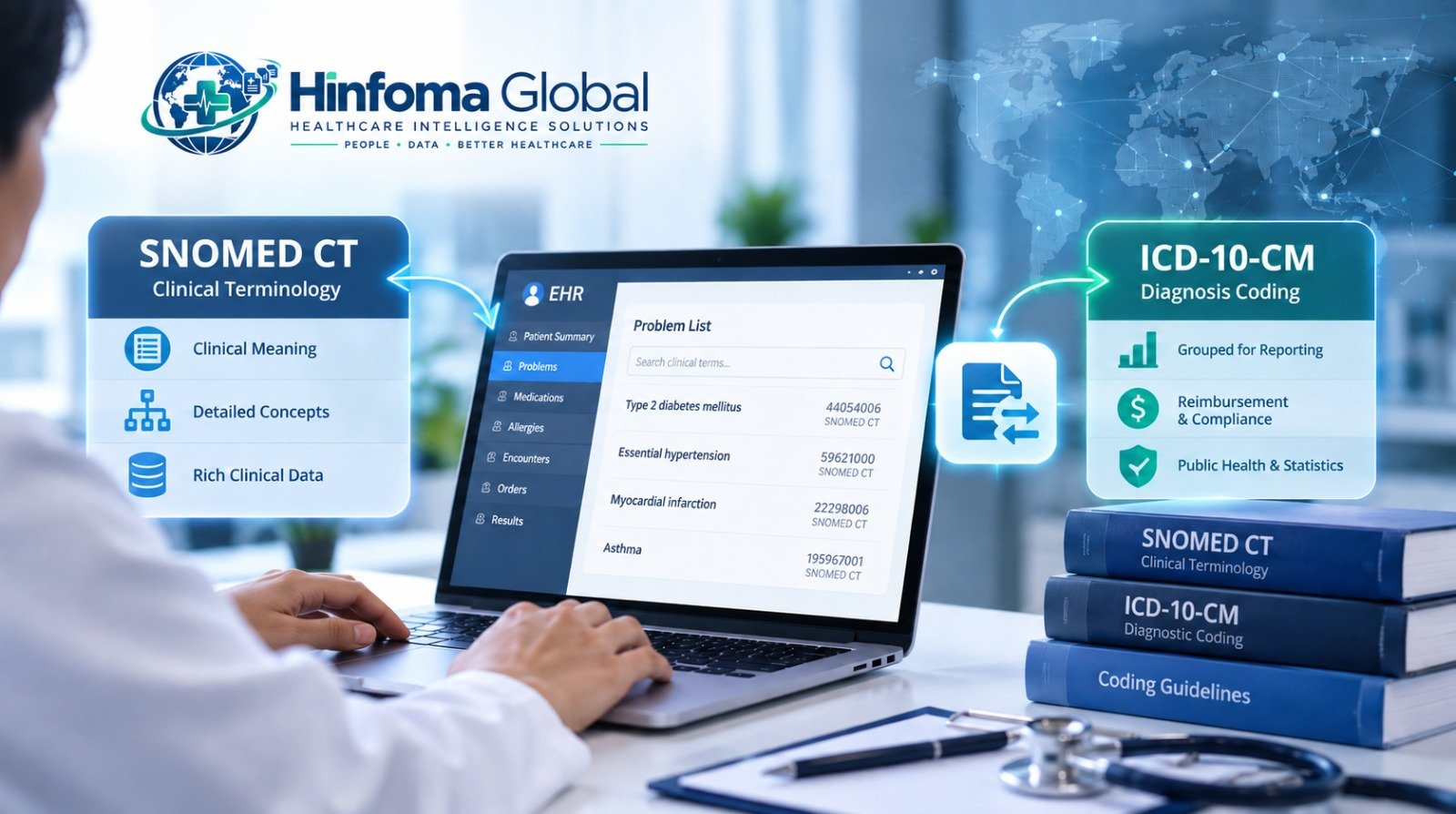
What Is SNOMED CT? A Practical Guide for Medical Coders and HIM Professionals
How the clinical terminology inside your EHR connects to ICD-10-CM, and why it matters for coding accuracy, CDI and compliance
Hinfoma Global LLC | HIM & Coding Insights | September 2026
Most medical coders work every day with ICD-10-CM, CPT and HCPCS. But long before a diagnosis reaches a claim, it is often recorded in the electronic health record (EHR) using a different language: SNOMED CT. When a physician picks “Type 2 diabetes mellitus” from a problem list, the EHR usually stores a SNOMED CT concept first and then translates it into an ICD-10-CM code.
Understanding that hidden step is becoming essential for coders, clinical documentation improvement (CDI) specialists, auditors and HIM leaders. This guide explains what SNOMED CT is, how it is structured, how it differs from ICD-10-CM, and where it affects coding quality.
What Is SNOMED CT?
SNOMED CT (Systematized Nomenclature of Medicine – Clinical Terms) is a comprehensive, multilingual clinical terminology used to record health information in electronic systems. It is owned and maintained by SNOMED International, a not-for-profit organization whose members include the United States and many other countries.
Where ICD-10-CM is a classification designed to group conditions for statistics and reimbursement, SNOMED CT is a terminology designed to capture clinical meaning in detail at the point of care. It contains hundreds of thousands of active concepts covering diseases, findings, procedures, body structures, organisms, substances, devices and more.
In the United States, the National Library of Medicine (NLM) distributes SNOMED CT free of charge to U.S. users through a UMLS license and publishes a U.S. Edition that adds content needed for American healthcare.
How Is SNOMED CT Structured?
SNOMED CT is built on three core components:
- Concepts: Each clinical idea has a unique numeric identifier (Concept ID). The ID carries no meaning by itself; it simply identifies the concept.
- Descriptions: Human-readable terms attached to each concept, including a Fully Specified Name (FSN) that is unambiguous and one or more synonyms that clinicians use in practice.
- Relationships: Links that define how concepts relate to one another. The most important is the “is a” relationship, which builds hierarchies. Attribute relationships add detail such as finding site, causative agent or procedure method.
For example, the concept Type 2 diabetes mellitus (44054006) “is a” Diabetes mellitus (73211009). Myocardial infarction (22298006) has a finding site in the heart muscle and an associated morphology of infarct. This logic allows computers to understand that a patient with type 2 diabetes also has diabetes, which supports reporting, decision support and quality measurement.
Concepts are organized under top-level hierarchies such as Clinical finding, Procedure, Body structure, Organism, Substance, Pharmaceutical/biologic product, Observable entity and Situation with explicit context.
How Is SNOMED CT Different from ICD-10-CM?
The two systems are complementary, not competing. SNOMED CT captures what the clinician means; ICD-10-CM groups that meaning for reporting and payment.
| Feature | SNOMED CT | ICD-10-CM |
| Type | Clinical terminology | Statistical classification |
| Primary purpose | Record clinical meaning at the point of care | Report diagnoses for reimbursement, statistics and public health |
| Maintained by | SNOMED International (U.S. Edition distributed by NLM) | CDC/NCHS, with guidelines approved by the Cooperating Parties |
| Level of detail | Very granular; hundreds of thousands of concepts | About 75,000 codes grouped by category |
| Code format | Numeric Concept IDs (6–18 digits) with no built-in meaning | Alphanumeric codes (3–7 characters) with structured meaning |
| Structure | Multiple hierarchies; a concept can have more than one parent | Single hierarchy by chapter, category and subcategory |
| Used on claims? | No | Yes, required under HIPAA for diagnosis reporting |
| Update cycle | Frequent International releases; U.S. Edition twice yearly | Annually on October 1, with possible April 1 updates |
Where Is SNOMED CT Used in U.S. Healthcare?
- EHR problem lists: Certified EHR technology uses SNOMED CT to record problems, and the U.S. Core Data for Interoperability (USCDI) names SNOMED CT as the standard for problems and several other data elements.
- Health information exchange: Structured clinical documents and FHIR-based exchange rely on SNOMED CT so that a diagnosis means the same thing in every receiving system.
- Quality measurement: Many CMS electronic clinical quality measures (eCQMs) use value sets that include SNOMED CT concepts.
- Clinical decision support and analytics: SNOMED CT hierarchies allow systems to find all patients with a condition and its subtypes, power alerts and support research.
- AI and natural language processing: Many computer-assisted coding and CDI tools extract clinical concepts from notes into SNOMED CT before suggesting ICD-10-CM codes.
How Does the SNOMED CT to ICD-10-CM Map Work?
NLM publishes an official SNOMED CT to ICD-10-CM map. It links SNOMED CT concepts to ICD-10-CM codes so that EHRs can suggest billing codes from clinical terms. The map is rule-based: some concepts map to a single code, while others depend on additional information such as the patient’s age, gender or laterality, or on whether a related condition is also present.
Common map outcomes include:
- One-to-one: the SNOMED CT concept maps directly to one ICD-10-CM code.
- Rule-based choice: the correct code depends on a condition such as age or an associated diagnosis.
- Multiple codes: a single clinical concept may require more than one ICD-10-CM code, reflecting “code first” or “use additional code” instructions.
- No map or context needed: some concepts cannot be mapped without further information from the record.
Important: The map is a tool, not a rulebook. It does not replace the ICD-10-CM Tabular List, Alphabetic Index or Official Guidelines for Coding and Reporting, and it cannot judge whether a condition meets the criteria for reporting in a given encounter.
Why Should Medical Coders and CDI Teams Care About SNOMED CT?
Even though SNOMED CT never appears on a claim, it shapes the codes that do. Common risks include:
- Auto-mapped codes accepted without review. A problem-list entry can generate an ICD-10-CM code that lacks the specificity, laterality or combination coding required by the guidelines.
- Outdated or inactive problem-list entries. Resolved conditions that remain on the problem list can flow into claims for encounters where they were not addressed.
- Loss of detail in translation. SNOMED CT may hold more detail than ICD-10-CM can express, or the reverse. Coders must confirm the final code against provider documentation.
- Mismatch after annual updates. When ICD-10-CM codes are deleted or expanded each October, map tables and EHR configurations must be updated or claims may carry invalid codes.
- AI-driven suggestions. Tools that extract SNOMED CT concepts from notes may suggest diagnoses that are documented but not clinically significant for the encounter.
Coders who understand SNOMED CT can trace why a code was suggested, spot mapping errors early and work with IT and CDI teams to fix the source rather than correcting the same error claim after claim.
What Are the Best Practices for Using SNOMED CT in Coding Workflows?
- Validate every mapped code. Treat EHR-suggested ICD-10-CM codes as a starting point and confirm them against documentation and the Official Guidelines.
- Maintain clean problem lists. Work with providers to resolve inactive problems and add specificity to active ones.
- Update maps with each code release. Review EHR and encoder mappings every October 1 (and April 1 when applicable), and after each SNOMED CT U.S. Edition release.
- Include terminology in audits. When auditing coding errors, check whether the root cause is a SNOMED CT selection, a map rule or the coder’s final choice.
- Train coders on terminology basics. A working knowledge of SNOMED CT concepts, hierarchies and the map makes coders more effective partners for CDI and IT teams.
Frequently Asked Questions About SNOMED CT
Does SNOMED CT replace ICD-10-CM?
No. SNOMED CT records clinical information in the EHR, while ICD-10-CM remains the required code set for reporting diagnoses on U.S. claims. The two work together.
Do medical coders assign SNOMED CT codes?
Usually not directly. Clinicians select SNOMED CT concepts through the EHR interface, often without seeing the Concept ID. Coders work with the ICD-10-CM codes that result, but benefit from understanding where those codes came from.
Is SNOMED CT free to use in the United States?
Yes, for U.S. users. The United States is a SNOMED International member, and NLM distributes SNOMED CT to U.S. users at no cost through a UMLS license.
What is the difference between the International Edition and the U.S. Edition?
The International Edition is maintained by SNOMED International. The U.S. Edition, published by NLM, combines the International Edition with additional content and changes needed for U.S. use.
Can the SNOMED CT to ICD-10-CM map be used to code claims automatically?
It can suggest codes, but final code assignment must follow the ICD-10-CM Official Guidelines and be supported by provider documentation. Automatic use without review increases compliance risk.
How Hinfoma Global Can Help
Hinfoma Global LLC helps U.S. hospitals, physician groups and health systems connect clinical documentation, terminology and coding so that every claim is accurate and defensible. Our services include:
- Coding audits that trace errors back to problem lists, map rules and EHR configuration
- Clinical documentation improvement (CDI) and problem-list cleanup programs
- Annual ICD-10-CM update readiness, including map and encoder reviews
- AI and computer-assisted coding validation
- Coder education on terminology, classification and compliance
To learn how we can support your organization, visit www.hinfomaglobal.com.
References
- SNOMED International. What is SNOMED CT? https://www.snomed.org/what-is-snomed-ct
- SNOMED International. Our Members. https://www.snomed.org/members
- National Library of Medicine. SNOMED CT (U.S. Edition). https://www.nlm.nih.gov/healthit/snomedct/index.html
- National Library of Medicine. SNOMED CT to ICD-10-CM Map. https://www.nlm.nih.gov/research/umls/mapping_projects/snomedct_to_icd10cm.html
- CMS Measures Management System. SNOMED CT. https://mmshub.cms.gov/measure-lifecycle/measure-specification/specify-code/SNOMED-CT
- ASTP/ONC. United States Core Data for Interoperability (USCDI). https://www.healthit.gov/isp/united-states-core-data-interoperability-uscdi
- CDC/NCHS. ICD-10-CM Files and Official Guidelines for Coding and Reporting. https://www.cdc.gov/nchs/icd/icd-10-cm/files.html
Disclaimer
This article is provided for general educational and informational purposes only and does not constitute legal, reimbursement, compliance or consulting advice. Concept IDs and examples are included for illustration; always verify against the current SNOMED CT release and the official ICD-10-CM code set in effect for the date of service. Code assignment must be based on complete provider documentation and the ICD-10-CM Official Guidelines for Coding and Reporting. SNOMED and SNOMED CT are registered trademarks of SNOMED International. Hinfoma Global LLC is an independent organization and is not affiliated with, endorsed by or sponsored by SNOMED International, the National Library of Medicine, CMS, ASTP/ONC or CDC/NCHS. All trademarks and registered names are the property of their respective owners.