
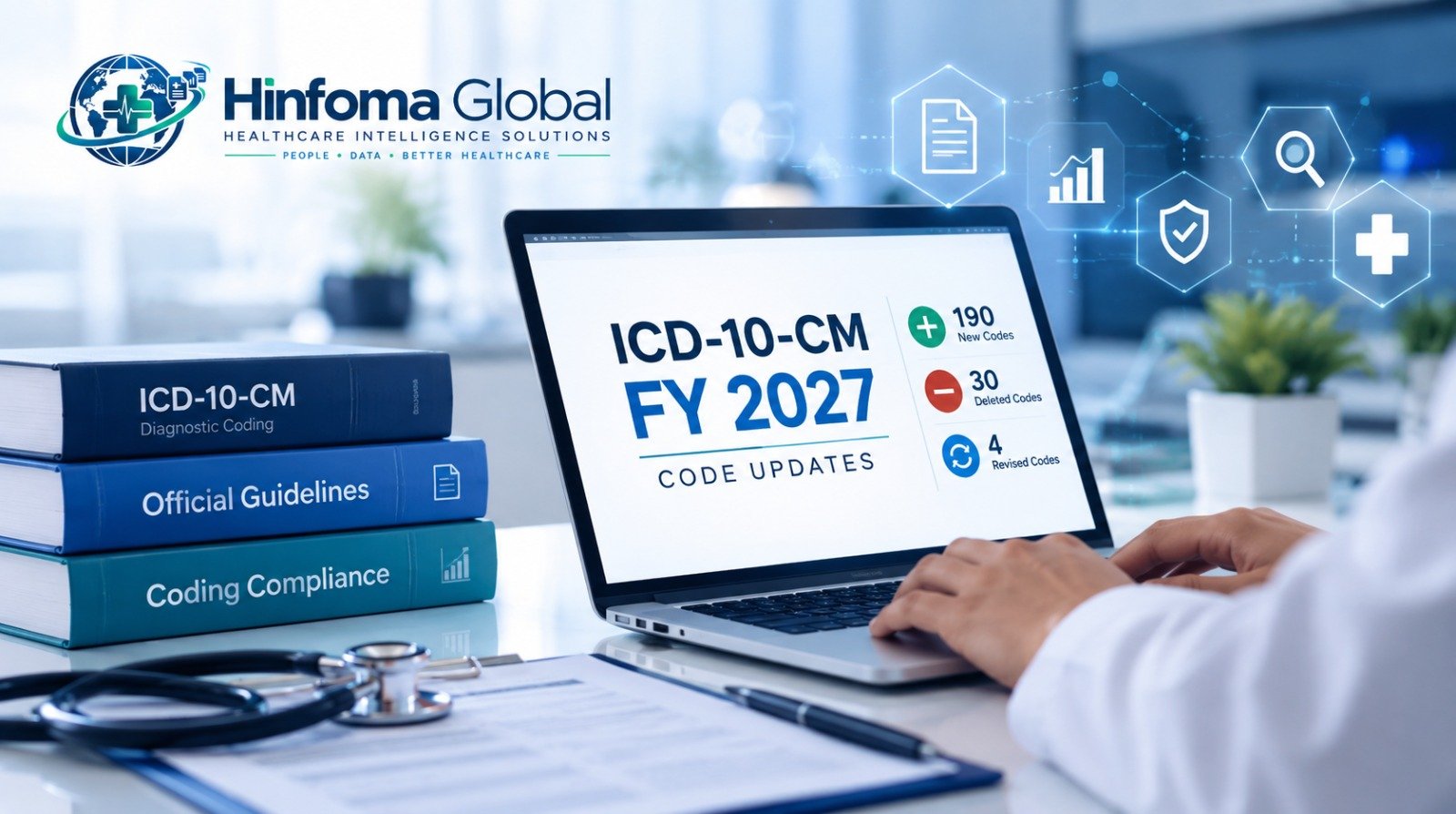
FY 2027 ICD-10-CM Code Updates
What coders, CDI specialists, auditors and revenue cycle teams must know about the code set effective October 1, 2026
Hinfoma Global | HIM, Coding Audit & Compliance Insights | September 2026
Every October 1, the diagnosis code set used across the U.S. healthcare system resets. For fiscal year (FY) 2027, the update is smaller than recent years in volume, but it is not small in impact. Several long-standing, billable codes have been converted into non-billable headers, a handful of Official Guidelines have been reworded, and new codes now capture genetic cancer syndromes, inherited arrhythmias, ectopic pregnancy location, low adult BMI and emerging toxic exposures with far greater precision.
This article breaks down the FY 2027 ICD-10-CM changes in plain language, explains why they matter clinically and financially, and highlights where coding audits and clinical documentation improvement (CDI) programs should focus in the first quarter of the new code year.
FY 2027 at a Glance
Effective period: Dates of service/discharges October 1, 2026 through September 30, 2027
New codes: 190
Deleted codes: 30
Revised code titles: 4
Total valid codes: approximately 74,879 (up from 74,719 in FY 2026)
Busiest chapters: Chapter 19 (Injury/Poisoning), Chapter 15 (Pregnancy) and Chapter 13 (Musculoskeletal)
Official sources: CMS and CDC/NCHS FY 2027 ICD-10-CM files, Tabular/Index addenda, Conversion Table and Official Guidelines
When Do the FY 2027 ICD-10-CM Codes Take Effect?
The FY 2027 code set applies to patient encounters and inpatient discharges from October 1, 2026 through September 30, 2027. The date of service (or date of discharge for inpatient claims) determines which code set applies, not the date the claim is submitted. A claim for a September 28, 2026 encounter must still use FY 2026 codes, even if it is billed in mid-October.
There is no grace period. Claims carrying a deleted code, or a code that has become a header, for a date of service on or after October 1, 2026 will be rejected as invalid.
Why Does This Year’s Update Matter If There Are Fewer New Codes?
Volume is not the right measure of risk. Three characteristics make FY 2027 a high-attention year:
- Billable codes became headers. Codes such as I42.0, I49.8, D69.1, M72.2, Z68.1 and Z87.890 were valid, reportable codes last year. Each now has new subcodes beneath it, so the parent code can no longer be reported. EHR favorites lists, charge-master mappings, superbills and problem lists that still point to these codes will generate rejections.
- Code title definitions narrowed. 01 (early hepatic fibrosis) now covers stage F1 only; stage F2 moves to the new K74.0A. A code that looks unchanged can now mean something different.
- Instructional notes changed type. Several Excludes1 notes became Excludes2 notes and vice versa. That silently changes which code combinations are allowed on the same claim.
What Changed in the FY 2027 ICD-10-CM Official Guidelines?
Guideline changes this year are limited, but each one clarifies a question that commonly surfaces in audits. Below is what changed and what it means in practice.
1. Hypertension with Heart Disease (Section I.C.9.a.1)
The guideline now states explicitly that the presumed link between hypertension and heart disease applies when the patient has “one or more” of the listed heart conditions. The listed conditions themselves are unchanged:
- – (heart failure), I51.4 (myocarditis, unspecified), I51.89 (other ill-defined heart diseases) or I51.9 (heart disease, unspecified): assign a code from category I11 plus an additional code from I50 or I51 for the heart condition.
- 5 (myocardial degeneration) or I51.7 (cardiomegaly): assign a code from category I11 only; no additional code is needed for the heart condition.
- If the provider documents that the heart condition is unrelated to the hypertension, code the conditions separately using I10 or a category I15 code.
Why it matters: The wording closes a gap where some coders hesitated to apply the I11 linkage when a patient had multiple qualifying heart conditions. It also reinforces that conditions not on the list, such as Takotsubo syndrome (I51.81), are not presumed to be hypertensive heart disease.
2. Hypertensive Crisis (Section I.C.9.a.10)
When a code from category I16 (hypertensive urgency, emergency or unspecified crisis) is assigned, the guideline now instructs coders to also report any identified hypertensive disease from I10–I15 and from category I1A (resistant hypertension). Previously, I1A was not named. Sequencing still depends on the reason for the encounter.
3. Chapter 17 Renamed to Include Genetic Disorders
Chapter 17 is now titled “Congenital malformations, deformations, chromosomal abnormalities, and genetic disorders” and its range extends from Q00–QA0 to Q00–QA1. The chapter guideline was updated throughout so that a genetic disorder is treated the same way as a malformation or chromosomal abnormality:
- A genetic disorder may be the principal/first-listed or a secondary diagnosis.
- If the genetic disorder has no unique code, report additional codes for its manifestations.
- If the code fully identifies the disorder, do not separately report manifestations that are inherent to it.
- Chapter 17 codes may be used throughout the patient’s life, whenever the condition is first diagnosed.
4. Diethylstilbestrol (DES) Exposure: Family History vs. Personal Risk (Section I.C.21)
The Chapter 21 guidelines now explain when to use each of the two DES-related Z codes. The distinction is generational:
| Code | Use When | Typical Documentation |
| Z91.B | The patient was personally exposed to DES in utero (patient’s mother took DES while pregnant with the patient) | “DES daughter” or “DES son”; second-generation exposure |
| Z84.A | A family member was exposed, placing the patient at higher risk (for example, the maternal grandmother took DES) | “DES granddaughter/grandson”; third-generation exposure |
Z91.B carries a “code also” note for associated conditions such as breast malignancy (C50.-), osteoporosis (M80.-) and premature menopause (E28.31-).
Which Chapters Had the Most Significant Code Changes?
Chapter 19 contributed roughly one-third of all new codes, driven by restructured toxic-effect codes. Chapter 15 added the second-largest group, followed by Chapter 13. Chapters 6, 7, 8, 16 and 20 have no new, deleted or revised codes this year.
| Chapter | Key FY 2027 Changes |
| 1 – Infectious & Parasitic | No new codes. Chapter-level Excludes1 for localized infections becomes Excludes2; new “code also” notes pair fungal infections (B37.1, B38.-, B44) with new pulmonary mycetoma code J4B. |
| 2 – Neoplasms | New secondary malignancy codes for larynx (C78.31), pharynx (C78.32) and oral cavity (C79.83). D05 note changes to Excludes1 for C50.-. |
| 3 – Blood & Immune | D69.1 expanded: D69.11 Glanzmann thrombasthenia, D69.19 other qualitative platelet defects. |
| 4 – Endocrine & Metabolic | New postprocedural hypoglycemia subcategory: E89.830 post-bariatric, E89.838 other. |
| 5 – Mental & Behavioral | New F64.A gender identity disorder, in remission. |
| 9 – Circulatory | Dilated cardiomyopathy expanded (I42.00, I42.01, I42.09); arrhythmogenic cardiomyopathy I42.81; CPVT I47.22; Brugada I49.81; ventricular bigeminy I49.82. |
| 10 – Respiratory | Odontogenic sinusitis by sinus (J34.830–J34.839); new pulmonary mycetoma J4B. |
| 11 – Digestive | K31.B pediatric hypertrophic pyloric stenosis; new K6A pelvic abscess block; K74.0A moderate hepatic fibrosis; K76.83 IFALD. |
| 12 – Skin | New L02.237 carbuncle of flank; “back” codes revised to exclude flank. |
| 13 – Musculoskeletal | VEXAS syndrome M04.3; plantar fasciitis M67.A- with laterality; plantar fibromatosis M72.2- and other osteomyelitis M86.8X- expanded by laterality/site. |
| 14 – Genitourinary | Postprocedural nipple ischemia (N99.860) and necrosis (N99.861). |
| 15 – Pregnancy | Interstitial, cesarean scar, cervical and cornual ectopic pregnancy codes; continuing pregnancy after vanishing twin (O31.4-). |
| 17 – Congenital & Genetic | Loeys-Dietz Q87.A; new QA1 block: Lynch syndrome, BRCA1/BRCA2 cancer syndromes, Li-Fraumeni. |
| 18 – Symptoms & Findings | R78.72 abnormal gadolinium level in blood; several Excludes notes changed. |
| 19 – Injury & Poisoning | T52.8X- replaced by T52.81- (alkenes), T52.82- (cycloparaffins), T52.89- (other solvents); new hexamethylene diisocyanate (T59.82-) and medetomidine (T65.85-) codes; S23.420 deleted. |
| 21 – Z Codes | Z29.14 title corrected (“immune globulin”); Z68.18/Z68.19 low adult BMI; gadolinium, burn pit, Agent Orange and blast overpressure exposure codes; Z86.17 history of C. difficile; gender transition history codes. |
What Are the Most Important New Codes Coders Should Learn First?
Cardiology: Inherited Cardiomyopathies and Arrhythmias
Inherited and genetic heart conditions that were previously buried in “other” codes now have their own codes. This improves risk stratification, registry reporting and medical necessity support for genetic testing, ICD implantation and family screening.
- 0 is now a header. Report I42.00 (dilated cardiomyopathy, unspecified; includes congestive cardiomyopathy NOS), I42.01 (familial-genetic dilated cardiomyopathy) or I42.09 (other dilated, nonfamilial).
- 8 is now a header. Report I42.81 (arrhythmogenic cardiomyopathy) or I42.89 (other cardiomyopathies NEC).
- 22 Catecholaminergic polymorphic ventricular tachycardia (CPVT), including familial polymorphic VT.
- 8 is now a header. Report I49.81 (Brugada syndrome), I49.82 (ventricular bigeminy; use additional codes for dizziness R42 or syncope R55 when present) or I49.89 (other specified arrhythmias, such as nodal or ectopic rhythm disorders).
Documentation tip: For dilated cardiomyopathy, CDI teams should prompt providers to state whether the condition is familial/genetic or nonfamilial. Without that detail, the claim defaults to the unspecified code.
Hepatology: A New Middle Stage of Liver Fibrosis
Hepatic fibrosis coding now mirrors the way clinicians stage disease. K74.01 (early fibrosis) is limited to stage F1 and mild fibrosis. The new K74.0A captures moderate fibrosis (stage F2). K74.02 remains advanced fibrosis. Coders must read the stage in the documentation, typically from elastography or biopsy results confirmed by the provider, rather than defaulting to “early.”
Also new is K76.83, intestinal failure-associated liver disease (IFALD), which carries an Excludes1 note for intestinal failure (K90.83).
ENT and Pulmonology: Odontogenic Sinusitis and Pulmonary Mycetoma
Sinusitis that originates from a dental source, such as an infected upper molar root or a complication after dental work near the maxillary sinus floor, now has its own subcategory, J34.83-, by sinus: maxillary (J34.830), ethmoid (J34.831), frontal (J34.832), sphenoid (J34.833) and unspecified (J34.839). This separates dental-origin disease from ordinary acute or chronic sinusitis, which is managed differently.
New code J4B identifies pulmonary mycetoma (fungal ball). It carries a “code also” note for the associated infection, such as aspergillosis (B44.-), chronic pulmonary coccidioidomycosis (B38.1) or pulmonary candidiasis (B37.1). The “chronic lower respiratory diseases” block expands from J40–J4A to J40–J4B.
Musculoskeletal: Laterality Arrives for Plantar Fasciitis and Osteomyelitis
Plantar fasciitis now has a dedicated subcategory, M67.A-, with codes for right foot (M67.A01), left foot (M67.A02) and unspecified foot (M67.A09). Plantar fascial fibromatosis (M72.2) is split into M72.20, M72.21 and M72.22.
Every “other osteomyelitis” site code from M86.8X1 through M86.8X8 has become a header, with new seven-character codes for right, left and unspecified sides. The “other site” group now separates skull (M86.8X80) and face and sinuses (M86.8X81) from other sites (M86.8X89).
Audit alert: Laterality-driven codes tend to generate a spike in unspecified-side coding in the first months. Payers increasingly flag unspecified laterality when the provider’s note clearly identifies a side. Auditors should sample these codes early.
Chapter 13 also adds M04.3, VEXAS syndrome, an adult-onset autoinflammatory disease.
Obstetrics: Ectopic Pregnancy Location and Vanishing Twin Syndrome
Chapter 15 brings the most granular additions of the year:
- Interstitial ectopic pregnancy (O00.12-, O00.13-), with laterality and with or without a coexisting intrauterine pregnancy.
- Cesarean scar ectopic pregnancy (O00.31, O00.32).
- Cervical ectopic pregnancy (O00.41, O00.42) and cornual ectopic pregnancy (O00.51-, O00.52-). Both were previously indexed to O00.8.
- Continuing pregnancy after vanishing twin syndrome of one fetus or more (O31.4-), by trimester and with a seventh character identifying the fetus.
Seventh-character reminder: Category O31 requires a seventh character. Use 0 for a single gestation or when the fetus is unspecified; use 1–9 to identify the fetus in a multiple gestation. Any O31 code with a seventh character of 1–9 also requires a code from category O30 (multiple gestation).
Genetics and Oncology: The New QA1 Block
The new QA1 block, “Genetic disorders associated with neoplasms, not elsewhere classified,” is one of the most clinically meaningful additions of FY 2027. It allows hereditary cancer predisposition to be coded as a diagnosis in its own right:
- 71 Lynch syndrome (hereditary nonpolyposis colorectal cancer susceptibility), including variants due to EPCAM, MLH1, MSH2, MSH6 and PMS2.
- 790 / QA1.791 Familial cancer syndrome with pathogenic BRCA1 or BRCA2 mutation (hereditary breast and ovarian cancer syndrome).
- 792 Li-Fraumeni syndrome.
- 798 Other inherited neoplasm predisposition syndrome of multiple systems.
The QA1 block instructs coders to also report associated conditions when applicable: genetic susceptibility to malignant neoplasm (Z15.0-), any active malignancy (C00.0–C96.9) and personal history of malignant neoplasm (Z85.-). Multiple endocrine neoplasia syndromes remain in E31.2- (Excludes2).
Chapter 17 also adds Q87.A for Loeys-Dietz syndrome, with Excludes1 notes separating it from Marfan syndrome, Ehlers-Danlos syndrome and arterial tortuosity syndrome.
Endocrine and Genitourinary: Postprocedural Complications
New subcategory E89.83- separates post-bariatric hypoglycemia (E89.830), which is common after gastric bypass, from other postprocedural hypoglycemia (E89.838). In Chapter 14, N99.860 and N99.861 capture intraoperative and postprocedural nipple ischemia and necrosis, complications most often seen after mastectomy and breast reconstruction.
Toxicology and Exposure Codes
The former T52.8X- “other organic solvents” codes were deleted and redistributed into three substance-specific groups: alkenes (T52.81-), cycloparaffins (T52.82-) and other organic solvents (T52.89-). New toxic-effect codes cover hexamethylene diisocyanate (T59.82-), an industrial chemical used in paints and coatings, and medetomidine (T65.85-), a veterinary sedative increasingly identified as an adulterant in the illicit drug supply. The medetomidine codes instruct coders to also report manifestations such as bradycardia (R00.1) or somnolence, stupor and coma (R40.-).
Exposure codes continue to grow in Chapter 21: gadolinium exposure (Z77.013, paired with new lab finding R78.72), burn pits in a war theater (Z77.32), Agent Orange (Z77.33, previously included under Z77.39) and blast overpressure (Z77.40, Z77.41, Z77.49).
Z Codes: Low BMI, History Codes and Allergy Updates
- 1 is now a header. Report Z68.18 (BMI 18.4 or less, adult) or Z68.19 (BMI 18.5–19.9, adult). This aligns the code with the clinical cutoff for underweight (below 18.5). BMI codes are still reported only as secondary codes with an associated reportable condition such as malnutrition, underweight or obesity.
- 17 Personal history of Clostridioides difficile infection (Excludes1: recurrent C. difficile enterocolitis, A04.71).
- 890 is now a header. New codes Z87.8901–Z87.8909 identify social, medical, surgical and unspecified gender transition history and intersex surgery; Z87.893 identifies gender detransition history.
- 014 Allergy to mammalian meats now includes the inclusion term alpha-gal syndrome (AGS).
- 5 Encounter for palliative care now lists comfort care and hospice care as inclusion terms.
- 0 Antenatal screening for chromosomal anomalies now lists Down syndrome, Patau syndrome, Trisomy 13, Trisomy 21 and fetal aneuploidy screening.
Which FY 2026 Codes Are No Longer Valid on October 1, 2026?
This is the single biggest source of avoidable denials each October. The table below lists former billable codes that are now headers or deleted, and where claims should go instead.
| FY 2026 Code (Now Invalid) | Former Description | Report Instead (FY 2027) |
| D69.1 | Qualitative platelet defects | D69.11 Glanzmann thrombasthenia; D69.19 other |
| I42.0 | Dilated cardiomyopathy | I42.00, I42.01, I42.09 |
| I42.8 | Other cardiomyopathies | I42.81 arrhythmogenic; I42.89 other |
| I49.8 | Other specified cardiac arrhythmias | I49.81, I49.82, I49.89 |
| M72.2 | Plantar fascial fibromatosis | M72.20, M72.21, M72.22 |
| M86.8X1–M86.8X8 | Other osteomyelitis, by site | Seven-character codes with right/left/unspecified |
| S23.420- | Sprain of sternoclavicular joint | Deleted – verify replacement in the Index/Conversion Table |
| T52.8X- | Toxic effect of other organic solvents | T52.81-, T52.82-, T52.89- |
| Z68.1 | BMI 19.9 or less, adult | Z68.18 or Z68.19 |
| Z87.890 | Personal history of sex reassignment | Z87.8901–Z87.8909 |
Always validate replacements against the official FY 2027 Conversion Table and Tabular List published by CMS and CDC/NCHS before updating system maps.
Which Instructional Note Changes Could Affect Claim Edits?
Excludes notes decide whether two codes can appear together. Changes this year include:
- Chapter 1 heading note for localized infections: Excludes1 → Excludes2 (codes may now be reported together when both conditions exist).
- A49 chlamydial infection NOS: Excludes1 → Excludes2.
- D05 carcinoma in situ of breast: note for malignant neoplasm of breast (C50.-) changed from Excludes2 → Excludes1.
- 2 difficulty in walking: unsteadiness on feet (R26.81) changed from Excludes1 → Excludes2.
- R79 abnormal blood chemistry: hyperglycemia NOS (R73.9) changed from Excludes1 → Excludes2.
- S22 rib, sternum and thoracic spine fractures: spinal cord injury (S24.0-, S24.1-) changed from “code also” to “code first, if applicable” – a sequencing change.
- 7 NIHSS score: the “code first” note now includes hemorrhagic strokes (I60.-, I61.-, I62.-) in addition to cerebral infarction (I63.-).
- 1 adult pyloric stenosis is now clearly separated from the new pediatric code K31.B and from congenital pyloric stenosis (Q40.0), which no longer includes the word “infantile.”
What Should Coding Audit and Compliance Teams Do Now?
Accurate diagnosis coding drives risk adjustment scores, MS-DRG assignment, medical necessity decisions and quality reporting. Errors introduced during a code-year transition are among the easiest for payers and government auditors to detect because they are systematic, not random. A focused readiness plan should include:
- System mapping review: Update EHR problem lists, favorites, order sets, charge masters, superbills and encoder logic to remove headers and deleted codes.
- Rejection monitoring: Track invalid-code rejections daily for the first 30–45 days after October 1 and trace each one to its root source.
- Targeted pre-bill audits: Sample high-volume areas first: cardiology (I42/I49), podiatry and orthopedics (M67.A, M86.8X), obstetrics (O00, O31.4), hepatology (K74.0-) and nutrition (Z68.1-).
- CDI query updates: Refresh query templates to capture familial vs. nonfamilial cardiomyopathy, fibrosis stage, sinus of origin, ectopic pregnancy site, laterality and genetic test results.
- Education: Brief coders and providers on changed Excludes notes and guideline wording, not only on new codes.
- Dates of service: Hold late-September encounters to FY 2026 codes; apply FY 2027 codes strictly by date of service or discharge.
Frequently Asked Questions About FY 2027 ICD-10-CM Updates
How many ICD-10-CM codes changed for FY 2027?
The FY 2027 update adds 190 new codes, deletes 30 codes and revises 4 code titles, bringing the code set to approximately 74,879 codes.
When must providers start using FY 2027 ICD-10-CM codes?
For all dates of service and inpatient discharges on or after October 1, 2026. The code set remains in effect through September 30, 2027.
Can I still report I42.0, I49.8 or Z68.1?
No. These codes became non-billable category headers on October 1, 2026. Report the more specific subcodes beneath them.
Were there major guideline changes in FY 2027?
No major overhauls. Changes clarify hypertension with heart disease, add resistant hypertension (I1A) to the hypertensive crisis guideline, extend the Chapter 17 guideline to genetic disorders and explain the two DES exposure Z codes.
Is Lynch syndrome now coded in Chapter 17?
Yes. Lynch syndrome is reported with QA1.71 in the new QA1 block. Code also any active malignancy, personal history of malignancy or genetic susceptibility code as applicable.
Where can I download the official FY 2027 ICD-10-CM files?
The official Tabular List, Index, addenda, Conversion Table and Official Guidelines are available on the CMS ICD-10 page and the CDC/NCHS ICD-10-CM files page (see References).
Is Your Organization Ready for FY 2027? Partner with Hinfoma Global
Hinfoma Global – HIM, Medical Coding & Compliance Services
Code updates do not fail on October 1; they fail quietly over the following months as outdated mappings, unspecified codes and missed documentation details reach payers. Hinfoma Global helps U.S. hospitals, physician groups and health systems close those gaps before they become denials or audit findings.
Coding audits: Pre-bill and retrospective diagnosis coding audits focused on FY 2027 high-risk areas.
Compliance reviews: Alignment with the ICD-10-CM Official Guidelines, CMS requirements and OIG compliance program guidance.
Clinical documentation improvement: Query template redesign and provider education for specificity and laterality.
EHR and revenue optimization: Code-map cleanup, rejection root-cause analysis and revenue integrity support.
Our approach is built on clinical reasoning, not code lookup: every code must be supported by what the provider documented and what the patient actually has. Contact us at www.hinfomaglobal.com to schedule an FY 2027 readiness audit.
References
- Centers for Medicare & Medicaid Services (CMS). ICD-10 Codes – 2027 ICD-10-CM & PCS Files. https://www.cms.gov/medicare/coding-billing/icd-10-codes
- Centers for Disease Control and Prevention, National Center for Health Statistics (CDC/NCHS). ICD-10-CM Files (FY 2027 Tabular List, Index, Addenda and Official Guidelines for Coding and Reporting). https://www.cdc.gov/nchs/icd/icd-10-cm/files.html
- American Hospital Association. Coding Clinic for ICD-10-CM/PCS – Official coding advice. https://www.codingclinicadvisor.com
Disclaimer
This article is provided for educational and informational purposes only and does not constitute legal, reimbursement or consulting advice. Code assignment must always be based on complete provider documentation and the official ICD-10-CM Tabular List, Alphabetic Index and Official Guidelines for Coding and Reporting in effect for the date of service. Hinfoma Global is an independent organization and is not affiliated with, endorsed by or sponsored by CMS, CDC/NCHS, the American Hospital Association, the American Medical Association or AHIMA. ICD-10-CM is maintained by the National Center for Health Statistics. All trademarks and registered names are the property of their respective owners.